Despite the name, Tesla’s “Full Self-Driving” is not a self-driving automated vehicle. It is a driver-assistance system that can steer, accelerate, and brake on its own—including through cities—but that requires a human driver to be ready to take over at any moment. Rather than being a fully driverless vehicle, it is in the same broad Level 2 category as other advanced driver-assistance systems now being approved under UN rules for “driver control assistance systems” (DCAS). While these systems may appear highly capable and are often marketed in ways that suggest a high degree of autonomy, they remain legally and technically dependent on a human supervising driver who must stay attentive, responsible and ready to intervene at any moment.
Further concerns
The European Transport Safety Council (ETSC) has raised additional concerns about two speed-related FSD functions:
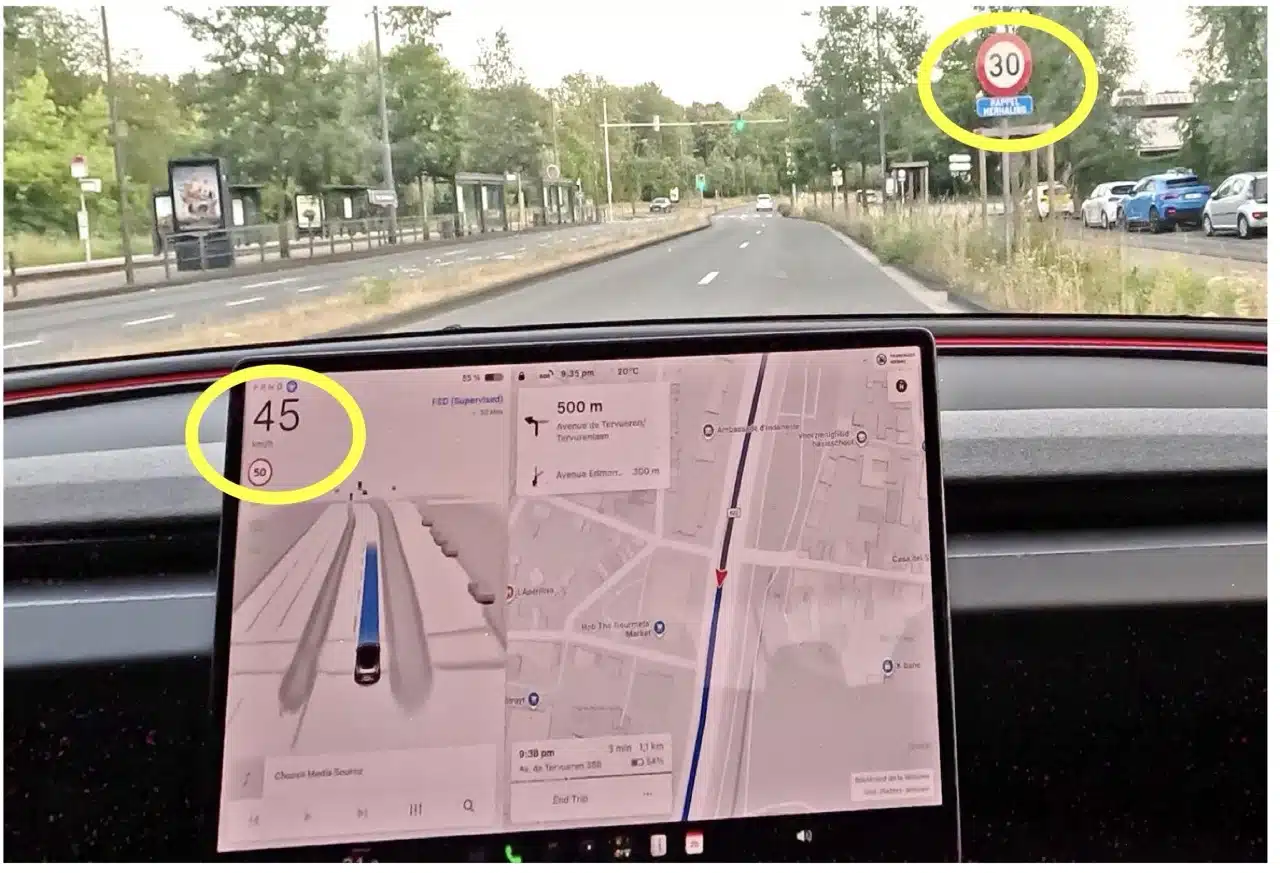
- “Speed offset” function – This can allow the maximum speed selected for FSD to be set up to 50% above a detected speed limit – meaning it could turn a 30 km/h zone into a 45 km/h limit or a 50 km/h street into 75 km/h. ETSC argues that this is illegal in the context of UN Regulation No. 171, which explicitly states that “the system shall not enable the driver to set a default offset by which the current maximum speed is supposed to exceed the system-determined road speed limit”.
- “Contextual max speed” function – This allows the system to its own speed ceiling/speed limit based on context from its surroundings, including the speed of other traffic. However, if speeding is widespread on European roads, then the speed of surrounding vehicles is not reliable evidence of what the legal limit actually is. A system that raises its own limit because other cars are speeding will only normalise law-breaking behaviour.
Note: Neither of these functions were active during johanna.be’s tests.
No Swiss approval without compliance
The recent findings, however, highlight concerns that extend beyond one manufacturer or one particular system. Automated vehicle technology is developing rapidly. While it may ultimately contribute to safer roads, technological progress must not come at the expense of established road-safety standards. This is particularly important in 20 and 30 km/h environments, where people walking and cycling depend on low vehicle speeds for their safety and for the quality of public space.
The FSD technology does not fit into the current EU/UN approval framework, so Tesla’s FSD did not go through the usual EU approval process. Instead, the Dutch vehicle authority (RDW) gave it a provisional approval earlier this year. Lithuania, Estonia, Belgium and Denmark have since chosen to accept this provisional approval. A full, EU-wide approval, however, still requires a vote by Member States in a technical committee, and an update to the relevant UN vehicle regulation.
This has not happened yet – a vote is expected later this year. If EU Member States approve Tesla FSD, the system would become eligible for use on Swiss roads. Pedestrian Mobility Switzerland calls on the competent Swiss authorities to monitor this progress and not to approve driving-assistance systems for use on Swiss roads, unless they can demonstrate that they consistently and reliably comply with applicable traffic laws. No vehicle system should be approved for use on Swiss roads if obeying the law remains optional.